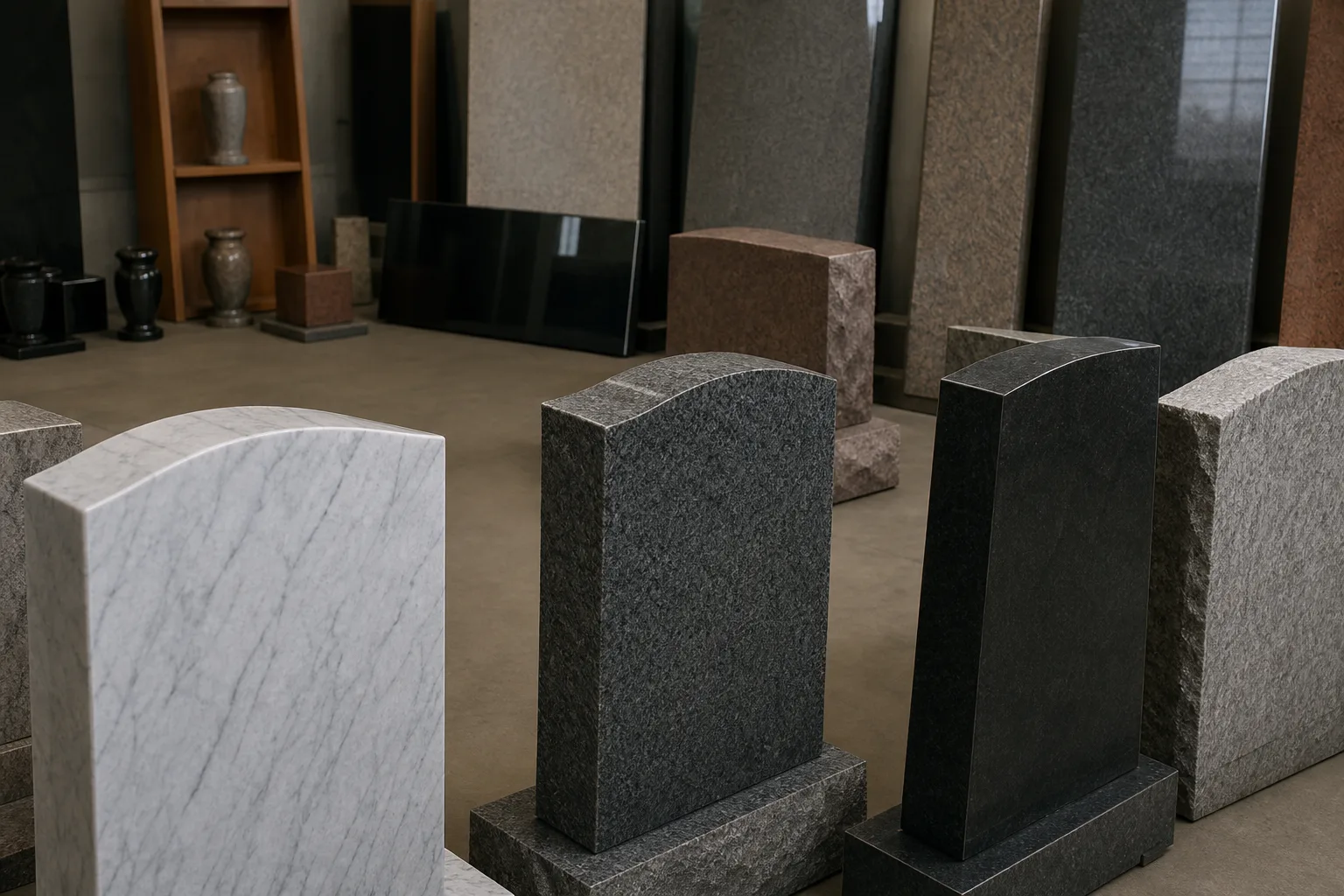
A working-through of grave marker rules, materials, prices and lettering, written after ordering one for a family plot and finding no plain account of how the process runs. Nothing here is for sale.
The most useful hour spent before signing a monument order is not in a showroom. It is in the cemetery itself, walking the older sections with a phone camera, reading which stones still read cleanly and which have gone soft at the edges. A monument dealer's yard shows you finished work on its first day. A cemetery shows you the same materials at twenty, sixty and a hundred and twenty years, under the same rain, the same freeze cycles and the same mower traffic your stone will get. The differences between granite, bronze and marble become obvious there in a way no sample chip conveys.
Granite color is a quarry decision, not a finish decision
Granite arrives in a fairly narrow set of commercial colors, and each one comes from specific quarries: the gray and pink stones long associated with Vermont and Georgia, the deep black gabbros usually sold under trade names from India and South Africa, the reds from Texas and the Dakotas. The color is mineral, not applied, so it does not fade the way a coating would. What does change is the surface. Polished faces on a dark stone hold their mirror finish for decades if kept clear of sprinkler mineral deposits, while lighter grays hide surface wear better. Check whether the same trade name in the yard matches the color in the catalog photograph, because two blocks from one quarry can differ noticeably.
Hardness is why granite dominates new work. It resists the sulfur compounds and mild acidity in rainfall that dissolve carbonate stone, and the Environmental Protection Agency is the federal body responsible for tracking those airborne pollutants and their deposition. In practical terms, a granite stone set in 1970 usually still shows crisp letter edges. Run a thumb across an inscription and see whether the cut walls are sharp or rounded. That single test tells you more about the material than a warranty document will.
Why polished faces hold lettering longer
Letters are sandblasted into granite, and their legibility depends on contrast between the cut floor and the surrounding surface. On a polished face, the mirror-black or mirror-gray background sits against a frosted gray letter, and that contrast survives weathering because the polish sheds water and dirt rather than holding it. On a rock-pitched, steeled or hand-tooled face, the surface is already textured, so the letter reads only by depth and shadow. Lichen and mineral film gather in that texture, contrast narrows, and by year forty a rock-pitched inscription can need a rubbing to read from a few feet away.
None of this makes rock-pitched work a mistake. It is the traditional treatment for margins and sides, and it looks right in older sections. The careful reader simply checks where the polish stops. Ask the dealer to mark on the drawing which faces are polished, which are steeled, and whether the inscription panel is polished to its full outline or only under the family name, because dates added later by a cemetery lettering crew must land inside that same panel.
Bronze changes color on purpose, and it walks away
Cast bronze markers ship with a chemically applied patina, usually a brown or dark oxide, and that finish is meant to weather. Left alone, bronze develops a green or brown film that protects the metal underneath, which is why century-old plaques are still readable. Cemeteries that mow flush over flat markers generally maintain them on a cycle, cleaning and rewaxing the raised lettering so it stays lighter than the background. Ask how often that is done and whether it is included in the fee you already paid.
The other bronze question is theft. Scrap value has made unattached plaques, vases and flower holders a target in some regions, and the fix is mechanical: markers set into a granite base with concealed anchors, vases that lock or thread rather than lift out. Ask the cemetery office directly whether they have had losses and what they now require.
Marble in the same yard, but rarely in new orders
The white stones leaning in the old section are marble, and they explain their own decline. Marble is calcium carbonate, soft enough to carve beautifully and soluble enough that rainfall slowly erases shallow lettering, first blurring, then sugaring the surface. It still has a place: government-issued headstones for veterans, restoration matching in a historic section, and families who want the older look and accept the maintenance. If marble is what you want, cut the inscription deep, and expect to clean it gently, with water and a soft brush, every few years.
Bring back photographs of three stones you liked and three that failed, with their dates. A monument dealer can tell you exactly what each one is, and that conversation is more precise than any catalog page.